Two ways to rank insurance brokers
Insurance brokers are usually ranked by revenue. Trade press rankings, such as Business Insurance's annual list of the 100 largest brokers of US business, order them by what they earn, which measures the size of the business. Revenue does not say how many licensed people sell for a broker, and that is what recruiters, vendors and agency buyers need to know.
This ranking counts licensed producers instead: the people in our agent file with a life and health or property and casualty license whose business email is on the broker's own domain.
The largest brokers by licensed producers
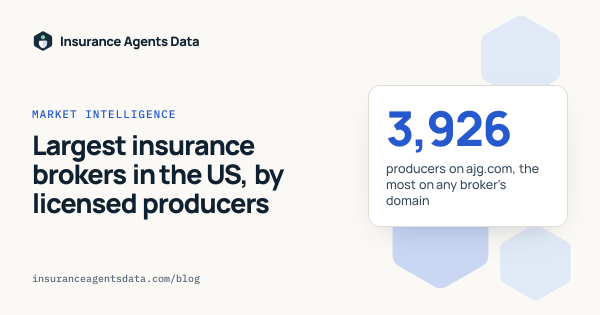
Gallagher leads with 3,926 producers on ajg.com, followed by Marsh McLennan Agency (3,065), USI (2,812), Aon (2,530) and WTW (2,102). In all, 15 brokers have more than 1,000 producers each on their own domain.
Read the counts as floors. A producer counts only if their record carries an email on the broker's own domain. Brokers that buy agencies often let them keep their own name and domain for years, so a broker built by acquisition, such as Acrisure, has many producers who still use the old agency's address. The file also holds more producers in Florida and Texas than in other states, so a broker that is strong there shows more of its people.

Brokers that share an owner
Some of these brands now share an owner. Aon completed its purchase of NFP on 25 April 2024, Marsh McLennan completed its purchase of McGriff on 15 November 2024 and folded it into Marsh McLennan Agency, and Gallagher completed its purchase of AssuredPartners on 18 August 2025. Each still appears under its own domain. Counted together, Marsh McLennan Agency, Marsh and McGriff, all owned by the company now branded Marsh, hold 5,682 producers; Gallagher with AssuredPartners and Risk Placement Services, its wholesale arm, 5,484; and Aon with NFP 3,268.

What each broker's producers sell
The licenses show what a broker sells. 80.4% of Gallagher's producers carry property and casualty authority, and most of the large brokers look much the same. OneDigital, an employee benefits broker, is the opposite: 98.6% of its producers hold life and health authority and 4.7% property and casualty. Ryan Specialty, a wholesale broker that places hard-to-write risks for other agents, is 99.6% property and casualty, and Goosehead, a franchise of personal lines agencies, 98.7%.
A producer can hold both licenses, so the two shares can add up to more than 100%. Lockton, with 55.8% of its producers licensed for life and health, has a large benefits practice next to its commercial one.

Aggregators, the other way agencies grow
In insurance, an aggregator means one of two things. Most often it is a buyer: a broker, usually backed by private equity, that buys independent agencies outright, the way Acrisure, Hub and AssuredPartners grew. The word also covers networks, sometimes called clusters, that independent agencies join for carrier access and shared services while keeping ownership of their book.
Both compete for the same independent agencies. If you are buying agencies yourself, how to buy an insurance agency or book of business covers how to reach owners before an aggregator does.
Reach a broker's producers, or leave them out
The domain of business_email is the filter. Recruiters use it to see where producers work today and in which cities: a broker's office shows up as a cluster of producers at one address. Vendors whose product a large broker buys centrally can leave those domains out and sell to independent agencies instead, and agency buyers drop the brokers' and the captive carriers' domains to keep the owners who are still independent.
Every state pack and the nationwide file carry business_email, agency_name and both license flags. Packs are $149 a state or $699 for all 1,755,282 records, and the free 1,000-row sample shows the columns.