Three ways lists are priced
Insurance agent lists are sold in three ways. Fixed files charge once per state or for the whole country. Subscriptions charge monthly and cap how many contacts you can export. Brokers charge per record, usually with a minimum order. The same list can look cheap or expensive depending on which you compare.
Published prices, October 2026
Our packs are $149 for a state and $699 for the nationwide file of 1,755,282 agents, one time, with bundle discounts for several states.
insuranceagentlists.com lists each state at $249 whatever its size, and its nationwide life and health file at $6,225 (store prices as listed on 16 October 2026). UpLead sells a nationwide file of 40,178 verified contacts for $3,499 and prices states by size, from $99 to $1,199 (23 October 2026). US Agent Data runs subscriptions: free for 10 exports a month, $49 a month for 10,000 and $199 a month for 100,000 (23 October 2026).
Compare the cost per usable contact
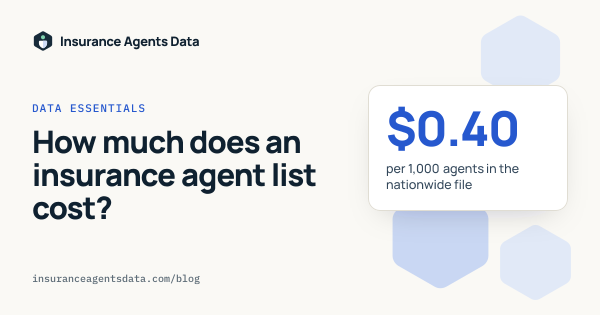
Divide the price by the contacts you can use. At $699 for 1,755,282 records our nationwide file is about $0.40 per thousand agents, or $0.58 per thousand counting only the 1,205,471 records with a business email. Run the same sum for any seller, using the records that carry the field you need, not the headline count.
Then check what a record holds. A list that includes license type, lines of authority and years licensed lets you segment before you send; one that is only a name and an email does not.

What a low price does not buy
No seller can promise that every email still reaches an inbox. Our email domains are checked to accept mail, but inboxes are not individually verified, so run your own verification before a large send. Read the refund terms too: most fixed-file sellers, including us, treat downloads as final.
Try before you buy
Download the free 1,000-row sample, open it in a spreadsheet and check the columns against your CRM. Then choose a state pack for one market or the nationwide file once you work in several; state pack vs. nationwide works out where the break-even sits.